
How can you estimate a building's energy performance when it has no EPC certificate?

How to close the gap in EPC coverage for energy renovation?
Suppose: you have a large portfolio of buildings that require energy renovation, but you don’t know where to start first.
An EPC certificate provides reliable information about a building’s energy performance. However, certificates are generally available only for properties that have recently been sold, rented or built.
For assessing individual buildings, this is rarely a problem. But when assessing an entire property portfolio, missing data becomes a major obstacle.
Property owners, consultants and banks all face the same challenge: buildings with certificates can be assessed, while those without remain largely unknown. Yet these are often the properties where renovation is most needed.

How the estimate works
Zadu makes it possible to assess the energy performance of buildings even when no EPC certificate is available. This allows property owners, banks and consultants to evaluate entire portfolios, identify less efficient buildings and prioritise renovation efforts.
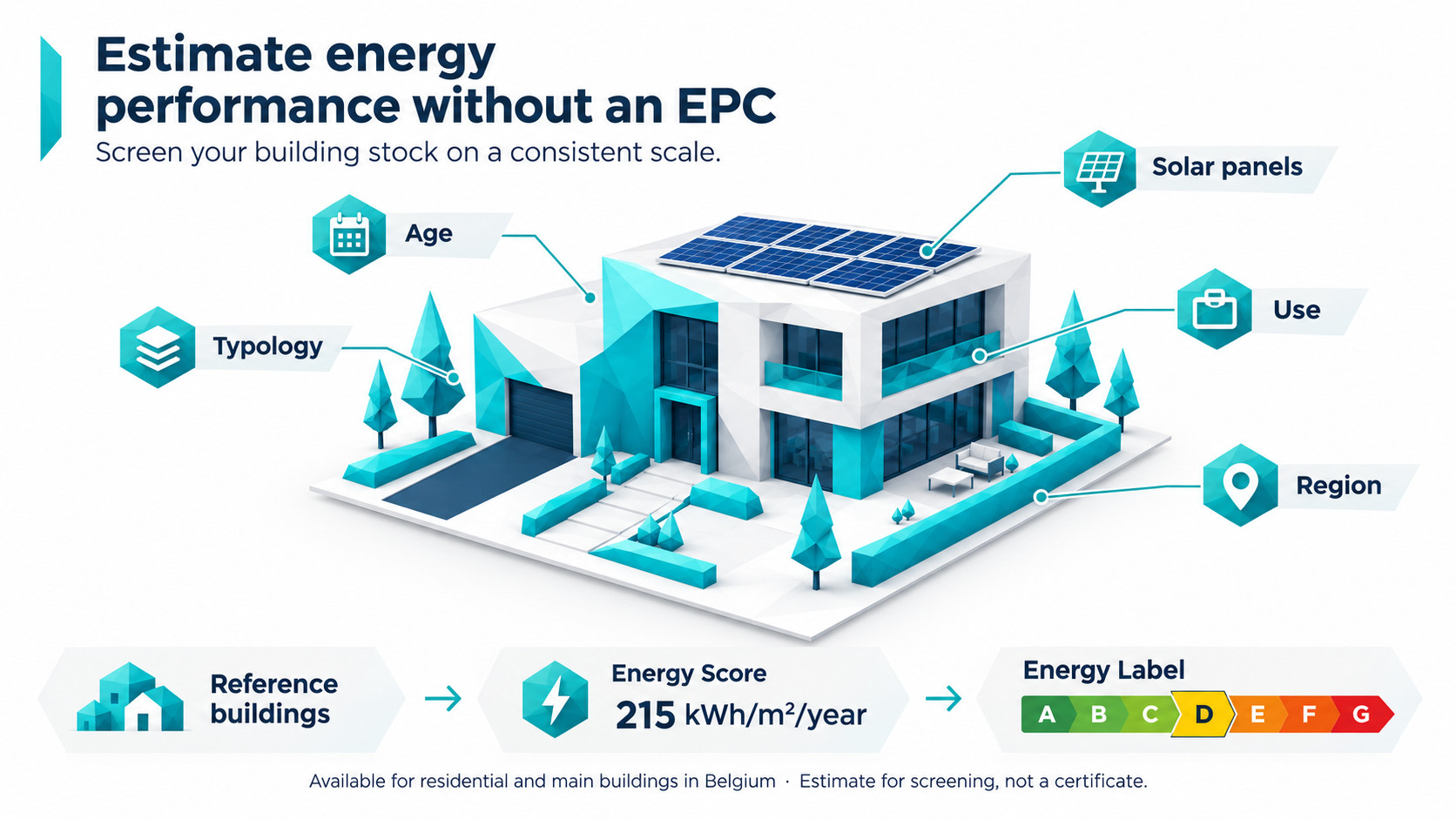
To estimate performance, the module compares each building with reference properties whose energy performance is known. It considers characteristics such as age, type, use, location and the presence of solar panels.
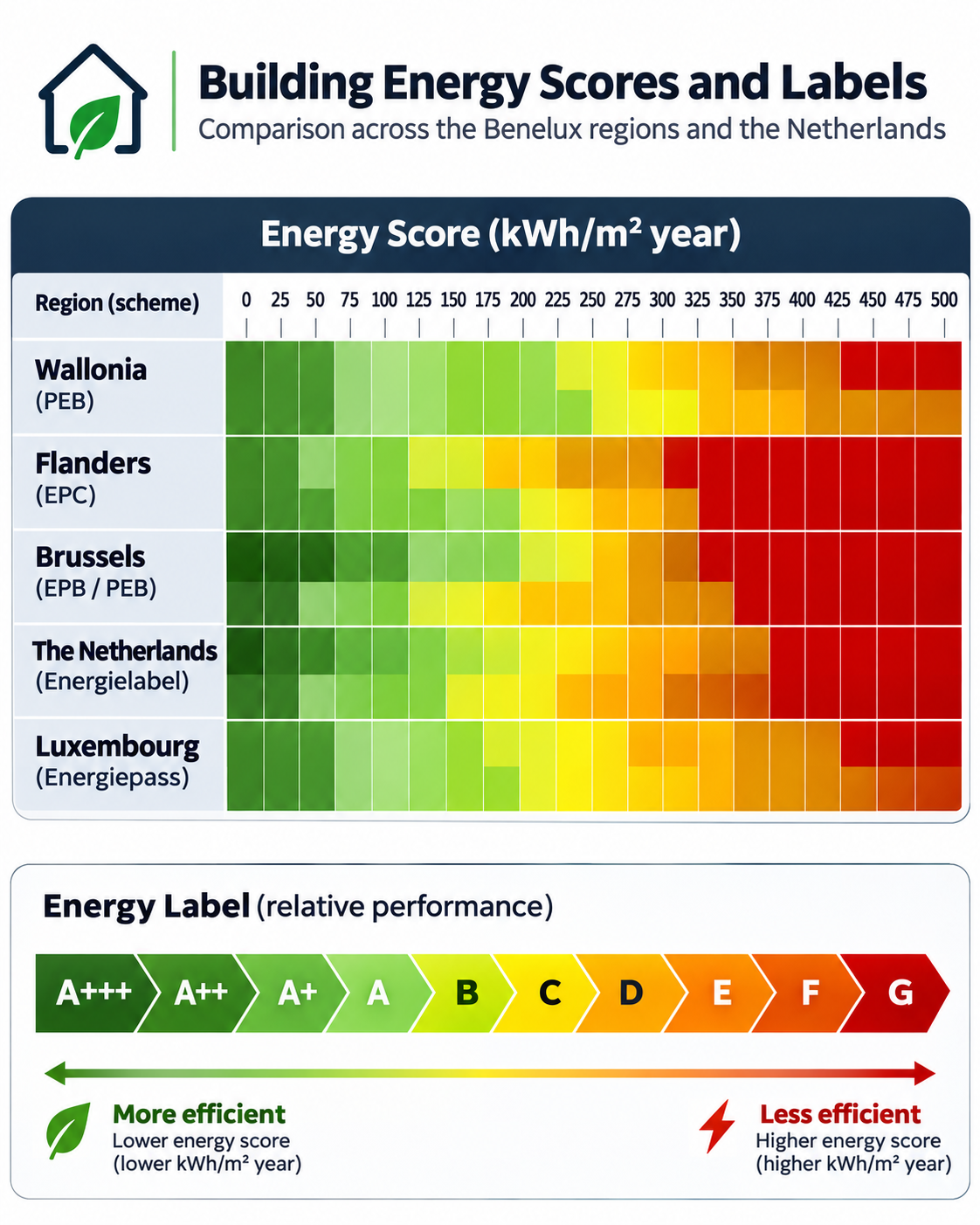
The result is an estimated Energy Score, expressed in kilowatt-hours per square metre per year (kWh/m²/year). The lower the score, the more energy-efficient the building.
This score is then converted into an energy label aligned with the official regional scales:
- EPC in Flanders,
- PEB in Wallonia
- PEB/EPB in Brussels.
Both the score and label are available in Zadu for all residential and main buildings in Belgium, providing a consistent basis for portfolio-wide screening.
A screening tool, not a certificate
An estimated energy label does not replace an official EPC certificate where one is legally required. The module's main advantage is its coverage. By estimating energy performance for buildings without certificates, it allows property owners, banks and consultants to assess entire portfolios on a consistent scale, identify less efficient buildings and prioritise those requiring further investigation or renovation.

Turning energy estimates into actionable insights
Estimated energy performance helps organisations make better decisions across entire property portfolios.
For renovation campaigns, it identifies which buildings to target first, even without an EPC certificate. Property owners can use it to prioritise investments and focus their budgets on buildings with the greatest improvement potential.
Insurers can use energy performance data to improve their risk assessments, while property valuers gain a consistent indicator for comparing buildings, including those without certificates.
In short
Key takeaways
- 01
Performance through comparison
The performance of an uncertified building is estimated by comparing it with reference buildings whose energy performance is known.
- 02
Five comparison factors
The comparison considers building age, typology, use, the presence of solar panels and region.
- 03
From energy score to label
The result is a score in kWh/m²/year, converted into an energy label aligned with Belgium’s three regional scales.
- 04
Coverage across Belgium
Energy estimates are available for all residential and main buildings in Belgium.
- 05
An estimate, not a certificate
Designed for portfolio-wide screening and prioritisation, not to replace an official energy performance certificate.
Cannot find the EPC certificate of a set of buildings and need help estimating their energy performance?
Discover how Zadu can assist you in determining where to place your renovation invstements most effectively.